MoreExam
1. Question Content...
EXPLANATION
Answer: X - EXPLANATION Content.
Question1: Your company has sensitive data in Cloud Storage buckets. Data analysts have Identity Access Management (IAM) permissions to read the buckets. You want to prevent data analysts from retrieving the data in the buckets from outside the office network. What should you do?
Question2: You are implementing the infrastructure for a web service on Google Cloud. The web service needs to receive and store the data from 500,000 requests per second. The data will be queried later in real time, based on exact matches of a known set of attributes. There will be periods where the web service will not receive any requests. The business wants to keep costs low. Which web service platform and database should you use for the application?
Question3: For this question, refer to the TerramEarth case study. A new architecture that writes all incoming data to BigQuery has been introduced. You notice that the data is dirty, and want to ensure data quality on an automated daily basis while managing cost.What should you do?
Question4: For this question, refer to the JencoMart case study.JencoMart has built a version of their application on Google Cloud Platform that serves traffic to Asi a. You want to measure success against their business and technical goals. Which metrics should you track?
Question5: Your company pushes batches of sensitive transaction data from its application server VMs to Cloud Pub/Sub for processing and storage. What is the Google-recommended way for your application to authenticate to the required Google Cloud services?
Question6: You write a Python script to connect to Google BigQuery from a Google Compute Engine virtual machine. The script is printing errors that it cannot connect to BigQuery. What should you do to fix the script?
Question7: You are managing an application deployed on Cloud Run for Anthos, and you need to define a strategy for deploying new versions of the application. You want to evaluate the new code with a subset of production traffic to decide whether to proceed with the rollout. What should you do?
Question8: You want to automate the creation of a managed instance group and a startup script to install the OS package dependencies. You want to minimize the startup time for VMs in the instance group.What should you do?
Question9: You are using Cloud CDN to deliver static HTTP(S) website content hosted on a Compute Engine instance group. You want to improve the cache hit ratio.What should you do?
Question10: Your customer support tool logs all email and chat conversations to Cloud Bigtable for retention and analysis.What is the recommended approach for sanitizing this data of personally identifiable information or payment card information before initial storage?
Question11: For this question, refer to the Mountkirk Games case study.Mountkirk Games wants you to design their new testing strategy. How should the test coverage differ from their existing backends on the other platforms?
Question12: Your web application has several VM instances running within a VPC. You want to restrict communications between instances to only the paths and ports you authorize, but you don't want to rely on static IP addresses or subnets because the app can autoscale. How should you restrict communications?
Question13: You have deployed several instances on Compute Engine. As a security requirement, instances cannot have a public IP address. There is no VPN connection between Google Cloud and your office, and you need to connect via SSH into a specific machine without violating the security requirements. What should you do?
Question14: For this question, refer to the Dress4Win case study.At Dress4Win, an operations engineer wants to create a tow-cost solution to remotely archive copies of database backup files. The database files are compressed tar files stored in their current data center. How should he proceed?
Question15: Your company has decided to make a major revision of their API in order to create better experiences for their developers. They need to keep the old version of the API available and deployable, while allowing new customers and testers to try out the new API. They want to keep the same SSL and DNS records in place to serve both APIs. What should they do?
Question16: Your company places a high value on being responsive and meeting customer needs quickly. Their primary business objectives are release speed and agility. You want to reduce the chance of security errors being accidentally introduced. Which two actions can you take? Choose 2 answers
Question17: You need to deploy an application on Google Cloud that must run on a Debian Linux environment. The application requires extensive configuration in order to operate correctly. You want to ensure that you can install Debian distribution updates with minimal manual intervention whenever they become available. What should you do?
Question18: You are monitoring Google Kubernetes Engine (GKE) clusters in a Cloud Monitoring workspace. As a Site Reliability Engineer (SRE), you need to triage incidents quickly. What should you do?
Question19: Your customer wants to do resilience testing of their authentication layer. This consists of a regional managed instance group serving a public REST API that reads from and writes to a Cloud SQL instance.What should you do?
Question20: Your company has multiple on-premises systems that serve as sources for reporting. The data has not been maintained well and has become degraded over time. You want to use Google-recommended practices to detect anomalies in your company dat a. What should you do?
Question21: For this question, refer to the JencoMart case study.The JencoMart security team requires that all Google Cloud Platform infrastructure is deployed using a least privilege model with separation of duties for administration between production and development resources. What Google domain and project structure should you recommend?
Question22: Your company wants to start using Google Cloud resources but wants to retain their on-premises Active Directory domain controller for identity management. What should you do?
Question23: You want your Google Kubernetes Engine cluster to automatically add or remove nodes based on CPUload. What should you do?
Question24: For this question, refer to the TerramEarth case study.TerramEarth's 20 million vehicles are scattered around the world. Based on the vehicle's location its telemetry data is stored in a Google Cloud Storage (GCS) regional bucket (US. Europe, or Asia). The CTO has asked you to run a report on the raw telemetry data to determine why vehicles are breaking down after 100 K miles. You want to run this job on all the dat a. What is the most cost-effective way to run this job?
Question25: You are developing a globally scaled frontend for a legacy streaming backend data API. This API expects events in strict chronological order with no repeat data for proper processing.Which products should you deploy to ensure guaranteed-once FIFO (first-in, first-out) delivery of data?
Question26: Your customer wants to capture multiple GBs of aggregate real-time key performance indicators (KPIs) from their game servers running on Google Cloud Platform and monitor the KPIs with low latency. How should they capture the KPIs?
Question27: You need to design a solution for global load balancing based on the URL path being requested. You need to ensure operations reliability and end-to-end in-transit encryption based on Google best practices.What should you do?
Question28: You need to ensure reliability for your application and operations by supporting reliable task a scheduling for compute on GCP. Leveraging Google best practices, what should you do?
Question29: One of your primary business objectives is being able to trust the data stored in your application. You want to log all changes to the application dat a. How can you design your logging system to verify authenticity of your logs?
Question30: For this question, refer to the Dress4Win case study. You want to ensure that your on-premises architecture meets business requirements before you migrate your solution.What change in the on-premises architecture should you make?
Question31: You are developing your microservices application on Google Kubernetes Engine. During testing, you want to validate the behavior of your application in case a specific microservice should suddenly crash. What should you do?
Question32: For this question, refer to the TerramEarth case study. TerramEarth has decided to store data files in Cloud Storage. You need to configure Cloud Storage lifecycle rule to store 1 year of data and minimize file storage cost.Which two actions should you take?
Question33: Your company acquired a healthcare startup and must retain its customers' medical information for up to 4 more years, depending on when it was created. Your corporate policy is to securely retain this data, and then delete it as soon as regulations allow.Which approach should you take?
Question34: You are working at a financial institution that stores mortgage loan approval documents on Cloud Storage. Any change to these approval documents must be uploaded as a separate approval file, so you want to ensure that these documents cannot be deleted or overwritten for the next 5 years. What should you do?
Question35: Your organization has decided to restrict the use of external IP addresses on instances to only approved instances. You want to enforce this requirement across all of your Virtual Private Clouds (VPCs). What should you do?
Question36: For this question, refer to the Dress4Win case study.Dress4Win has end-to-end tests covering 100% of their endpoints. They want to ensure that the move to the cloud does not introduce any new bugs. Which additional testing methods should the developers employ to prevent an outage?
Question37: You are running a cluster on Kubernetes Engine to serve a web application. Users are reporting that a specific part of the application is not responding anymore. You notice that all pods of your deployment keep restarting after 2 seconds. The application writes logs to standard output. You want to inspect the logs to find the cause of the issue. Which approach can you take?
Question38: For this question refer to the TerramEarth case study.Which of TerramEarth's legacy enterprise processes will experience significant change as a result of increased Google Cloud Platform adoption.
Question39: For this question, refer to the EHR Healthcare case study. You are a developer on the EHR customer portal team. Your team recently migrated the customer portal application to Google Cloud. The load has increased on the application servers, and now the application is logging many timeout errors. You recently incorporated Pub/Sub into the application architecture, and the application is not logging any Pub/Sub publishing errors. You want to improve publishing latency. What should you do?
Question40: For this question, refer to the TerramEarth case study. Considering the technical requirements, how should you reduce the unplanned vehicle downtime in GCP?
Question41: You have deployed an application to Kubernetes Engine, and are using the Cloud SQL proxy container to make the Cloud SQL database available to the services running on Kubernetes. You are notified that the application is reporting database connection issues. Your company policies require a post-mortem. What should you do?
Question42: Your company has announced that they will be outsourcing operations functions. You want to allow developers to easily stage new versions of a cloud-based application in the production environment and allow the outsourced operations team to autonomously promote staged versions to production. You want to minimize the operational overhead of the solution. Which Google Cloud product should you migrate to?
Question43: You are building a continuous deployment pipeline for a project stored in a Git source repository and want to ensure that code changes can be verified deploying to production. What should you do?
Question44: For this question, refer to the Dress4Win case study. You are responsible for the security of data stored in Cloud Storage for your company, Dress4Win. You have already created a set of Google Groups and assigned the appropriate users to those groups. You should use Google best practices and implement the simplest design to meet the requirements.Considering Dress4Win's business and technical requirements, what should you do?
Question45: For this question, refer to the EHR Healthcare case study. You need to define the technical architecture for securely deploying workloads to Google Cloud. You also need to ensure that only verified containers are deployed using Google Cloud services. What should you do? (Choose two.)
Question46: You are tasked with building an online analytical processing (OLAP) marketing analytics and reporting tool.This requires a relational database that can operate on hundreds of terabytes of dat a. What is the Google recommended tool for such applications?
Question47: A development team at your company has created a dockerized HTTPS web application. You need to deploy the application on Google Kubernetes Engine (GKE) and make sure that the application scales automatically.How should you deploy to GKE?
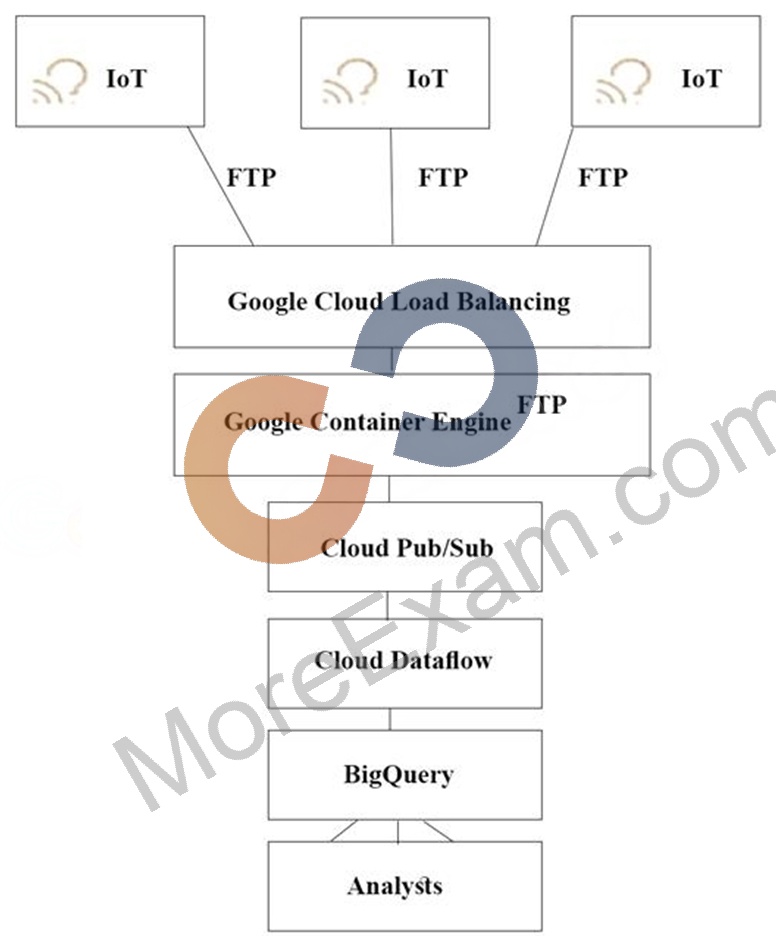
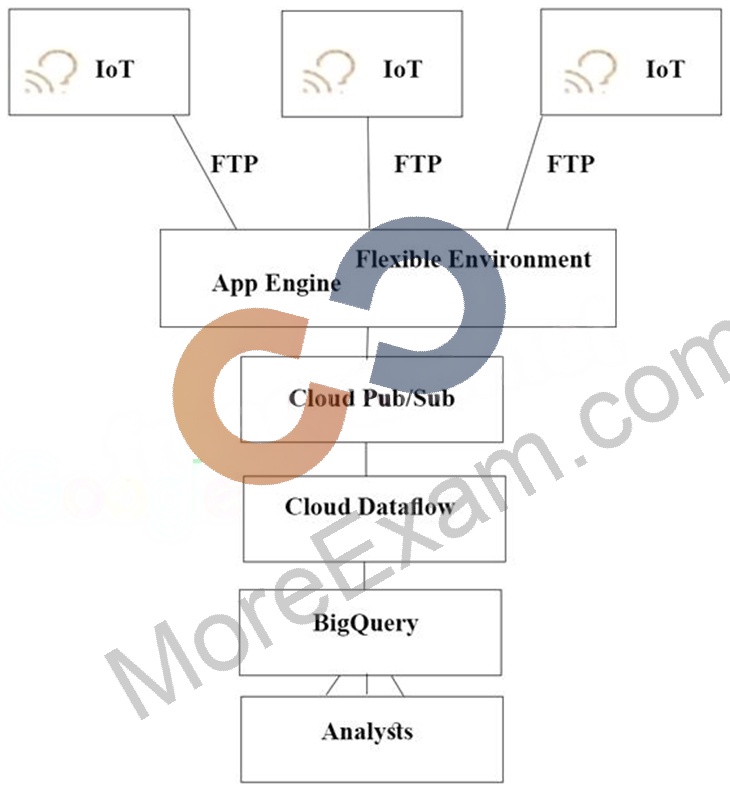
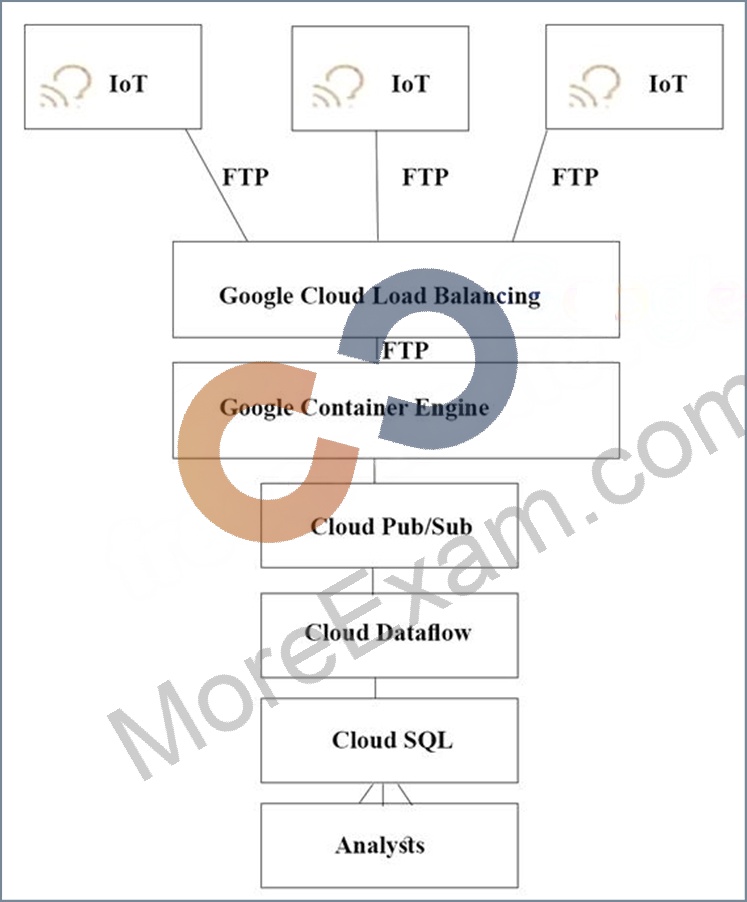
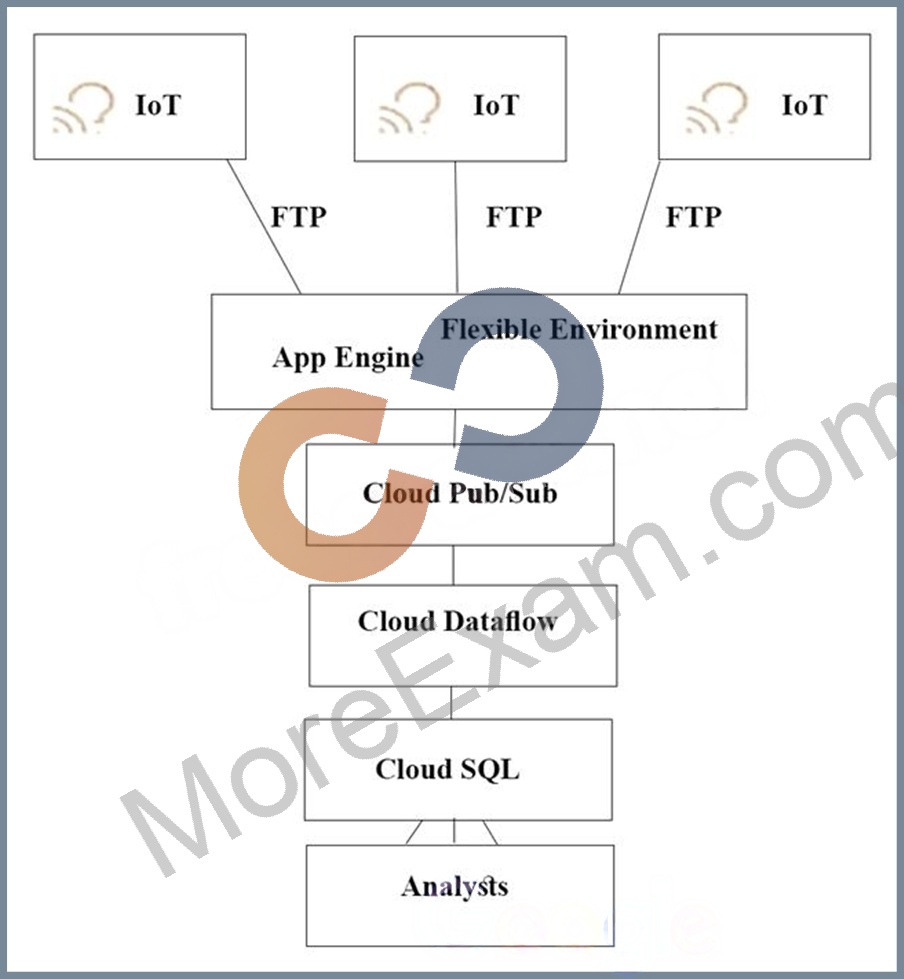
Question48: For this question, refer to the TerramEarth case study.TerramEarth's CTO wants to use the raw data from connected vehicles to help identify approximately when a vehicle in the development team to focus their failure. You want to allow analysts to centrally query the vehicle dat a. Which architecture should you recommend?A)B)C)D)
Question49: For this question, refer to the Mountkirk Games case study. You need to analyze and define the technical architecture for the compute workloads for your company, Mountkirk Games. Considering the Mountkirk Games business and technical requirements, what should you do?
Question50: For this question refer to the TerramEarth case studyOperational parameters such as oil pressure are adjustable on each of TerramEarth's vehicles to increase their efficiency, depending on their environmental conditions. Your primary goal is to increase the operating efficiency of all 20 million cellular and unconnected vehicles in the field How can you accomplish this goal?
Question51: Your company has decided to build a backup replica of their on-premises user authentication PostgreSQL database on Google Cloud Platform. The database is 4 TB, and large updates are frequent. Replication requires private address space communication. Which networking approach should you use?
Question52: Mountkirk Games wants you to secure the connectivity from the new gaming application platform to Google Cloud. You want to streamline the process and follow Google-recommended practices. What should you do?
Question53: Dress4win has end to end tests covering 100% of their endpoints.They want to ensure that the move of cloud does not introduce any new bugs.Which additional testing methods should the developers employ to prevent an outage?
Question54: For this question, refer to the Dress4Win case study.Dress4Win has configured a new uptime check with Google Stackdriver for several of their legacy services. The Stackdriver dashboard is not reporting the services as healthy. What should they do?
Question55: Your web application must comply with the requirements of the European Union's General Data Protection Regulation (GDPR). You are responsible for the technical architecture of your web application. What should you do?
Question56: You are moving an application that uses MySQL from on-premises to Google Cloud. The application will run on Compute Engine and will use Cloud SQL. You want to cut over to the Compute Engine deployment of the application with minimal downtime and no data loss to your customers. You want to migrate the application with minimal modification. You also need to determine the cutover strategy. What should you do?
Question57: For this question, refer to the TerramEarth case study. To be compliant with European GDPR regulation, TerramEarth is required to delete data generated from its European customers after a period of 36 months when it contains personal dat a. In the new architecture, this data will be stored in both Cloud Storage and BigQuery. What should you do?
Question58: Your application needs to process credit card transactions. You want the smallest scope of Payment Card Industry (PCI) compliance without compromising the ability to analyze transactional data and trends relating to which payment methods are used. How should you design your architecture?
Question59: For this question, refer to the TerramEarth case study.To speed up data retrieval, more vehicles will be upgraded to cellular connections and be able to transmit data to the ETL process. The current FTP process is error-prone and restarts the data transfer from the start of the file when connections fail, which happens often. You want to improve the reliability of the solution and minimize data transfer time on the cellular connections. What should you do?
Question60: For this question, refer to the TerramEarth case studyYou analyzed TerramEarth's business requirement to reduce downtime, and found that they can achieve a majority of time saving by reducing customers' wait time for parts You decided to focus on reduction of the 3 weeks aggregate reporting time Which modifications to the company's processes should you recommend?
Question61: You want to make a copy of a production Linux virtual machine in the US-Central region. You want to manage and replace the copy easily if there are changes on the production virtual machine. You will deploy the copy as a new instances in a different project in the US-East region. What steps must you take?
Question62: Your company has successfully migrated to the cloud and wants to analyze their data stream to optimize operations. They do not have any existing code for this analysis, so they are exploring all their options. These options include a mix of batch and stream processing, as they are running some hourly jobs and live-processing some data as it comes in. Which technology should they use for this?
Question63: Your team will start developing a new application using microservices architecture on Kubernetes Engine. As part of the development lifecycle, any code change that has been pushed to the remote develop branch on your GitHub repository should be built and tested automatically. When the build and test are successful, the relevant microservice will be deployed automatically in the development environment. You want to ensure that all code deployed in the development environment follows this process. What should you do?
Question64: You want to create a private connection between your instances on Compute Engine and your on-premises data center. You require a connection of at least 20 Gbps. You want to follow Google-recommended practices.How should you set up the connection?
Question65: For this question, refer to the EHR Healthcare case study. You are responsible for ensuring that EHR's use of Google Cloud will pass an upcoming privacy compliance audit. What should you do? (Choose two.)
Question66: You need to upload files from your on-premises environment to Cloud Storage. You want the files to be encrypted on Cloud Storage using customer-supplied encryption keys. What should you do?
Question67: All compute Engine instances in your VPC should be able to connect to an Active Directory server on specific ports. Any other traffic emerging from your instances is not allowed. You want to enforce this using VPC firewall rules.How should you configure the firewall rules?
Question68: Your company plans to migrate a multi-petabyte data set to the cloud. The data set must be available 24hrs a day. Your business analysts have experience only with using a SQL interface. How should you store the data to optimize it for ease of analysis?
Question69: Your company just finished a rapid lift and shift to Google Compute Engine for your compute needs. You have another 9 months to design and deploy a more cloud-native solution. Specifically, you want a system that is no-ops and auto-scaling. Which two compute products should you choose? Choose 2 answers
Question70: Your company sends all Google Cloud logs to Cloud Logging. Your security team wants to monitor the logs. You want to ensure that the security team can react quickly if an anomaly such as an unwanted firewall change or server breach is detected. You want to follow Google-recommended practices. What should you do?
Question71: You are working in a highly secured environment where public Internet access from the Compute Engine VMs is not allowed. You do not yet have a VPN connection to access an on-premises file server. You need to install specific software on a Compute Engine instance. How should you install the software?
Question72: You have an application that makes HTTP requests to Cloud Storage. Occasionally the requests fail with HTTP status codes of 5xx and 429.How should you handle these types of errors?
Question73: You need to reduce the number of unplanned rollbacks of erroneous production deployments in your company's web hosting platform. Improvement to the QA/Test processes accomplished an 80% reduction. Which additional two approaches can you take to further reduce the rollbacks? Choose 2 answers
Question74: Your organization requires that metrics from all applications be retained for 5 years for future analysis in possible legal proceedings. Which approach should you use?
Question75: Your customer runs a web service used by e-commerce sites to offer product recommendations to users. The company has begun experimenting with a machine learning model on Google Cloud Platform to improve the quality of results.What should the customer do to improve their model's results over time?
Question76: Your company provides a recommendation engine for retail customers. You are providing retail customers with an API where they can submit a user ID and the API returns a list of recommendations for that user. You are responsible for the API lifecycle and want to ensure stability for your customers in case the API makes backward-incompatible changes. You want to follow Google-recommended practices. What should you do?
Question77: Your development teams release new versions of games running on Google Kubernetes Engine (GKE) daily.You want to create service level indicators (SLIs) to evaluate the quality of the new versions from the user's perspective. What should you do?